The Timetable Is the Network
Percolation theory for scheduled transport networks
The Finding
Of every 100 tonnes of cryogenic propellant dispatched from Earth toward Jupiter via relay chain, fewer than 3 arrive. This is not an insulation problem or a budget problem. It is a consequence of orbital mechanics and hydrogen thermodynamics that no relay architecture with passive cryogenic storage can overcome.
The Framework
TIN computes delivery ratios for any scheduled transport network through a factorization: DR = ST × η. A single diagnostic, gamma, classifies networks as CLUSTER (path diversity helps) or TRAP (adding routes makes things worse). The framework screens commodity-dependent feasibility before hardware is committed. Validated across 290,000+ configurations spanning 8 planetary bodies and 5 terrestrial contact datasets.
The factorization is an arithmetic identity. The γ classification is derived from it. Configuration counts are simulation results. Policy implications are inferences from those results.
The Phase Diagram
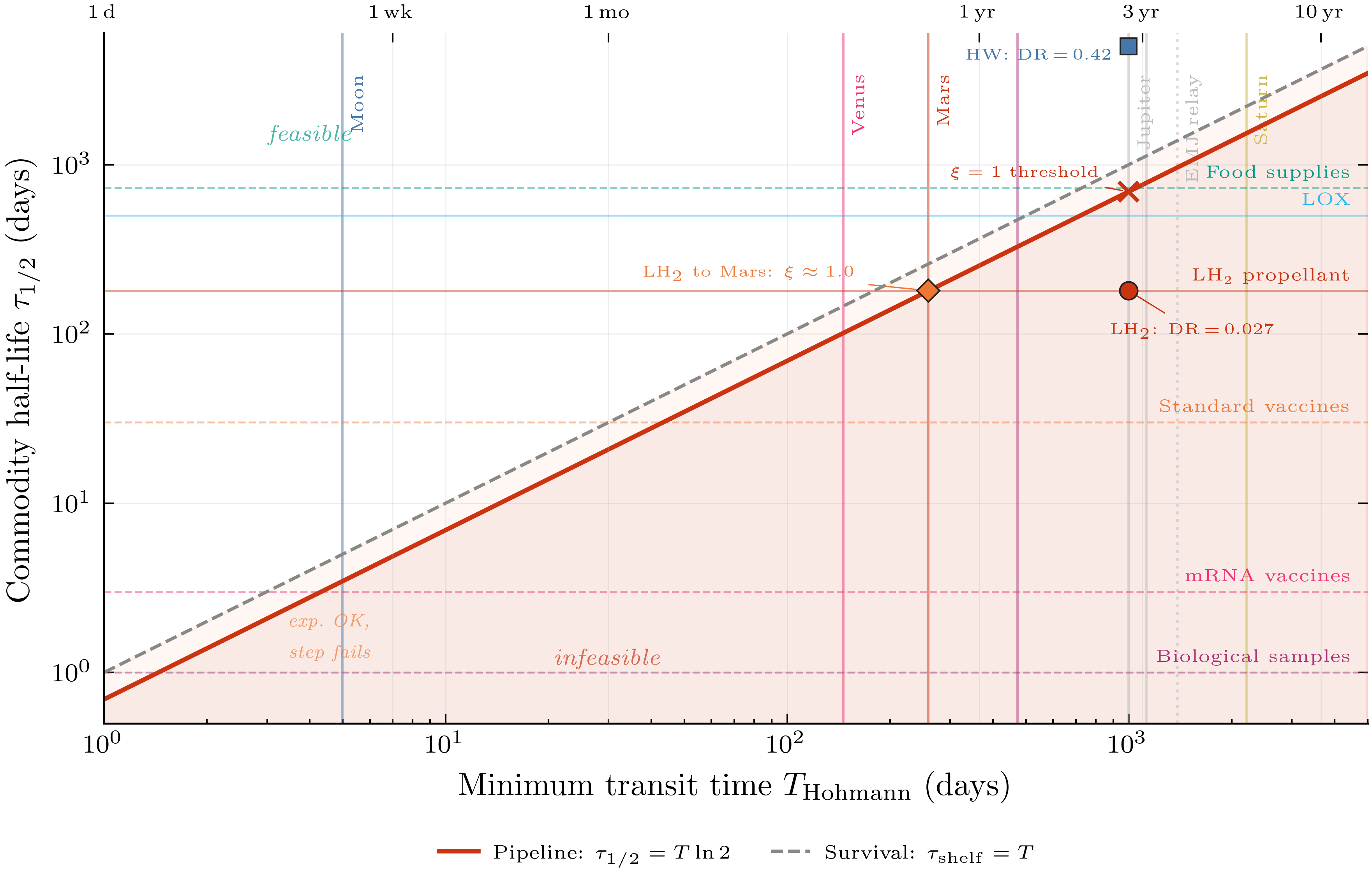
Interactive Tools
- Sparse Law Calculator — predict delivery ratios from network parameters using the three-factor sparse law
- Solar System Orrery — 3D explorer with orbital mechanics, DTN contact links, and constellation overlays
Papers
- A classification framework for temporal contact graphs — the factorization DR = ST × η, trap/cluster dichotomy, 155,000+ configurations
- From classification to mechanism in temporal contact networks — why networks trap: Var[ln p] mechanism, four-route taxonomy, layered diagnostic hierarchy
- Percolation-optimal relay architectures for cislunar and interplanetary networks — 89,178 configurations, Braess paradox, design rules for Artemis/Gateway and Mars Sample Return
- Jβ saturation invariance and TASEP phase structure in DTN relay networks — load-dependent phase transitions, universal current ceiling, golden-mean falsification
- Policy brief: Jupiter cryogenic propellant — two-page summary of implications for relay architecture planning
Code & Data
- github.com/toxic2040/TIN — source code, simulation engine, 298 experiment runners
- License: AGPL-3.0-or-later
About
J. Councilman is an independent researcher applying percolation theory to scheduled transport networks. The core method: decompose aggregate metrics into their upstream causes before reaching for complex explanations. 290,000+ configurations tested, all code open-source.